Skip to content

Nonprofits and charities

Audit week, without the scavenger hunt.

Grant agreements, gift agreements, board minutes and the receipt behind every grant expense, filed where your finance team, your auditor and your board can find them. Made for small teams that do not have an IT department.

The auditor's request list, nearly doneAn audit request list with six items. Board minutes, grant agreements, gift agreements for restricted gifts, invoices for sampled expenses and timesheets for grant-funded staff are all found. Signed conflict of interest statements are still waiting on two board members.Audit request listFiscal year ended June 30 · fieldwork MondayBoard minutes for the fiscal yearSigned, filed by meeting dateGrant agreements and award lettersOne file per grantGift agreements behind restricted giftsFiled by donorInvoices for 25 sampled expensesFound by invoice numberTimesheets for grant-funded staffFiled by employee and periodSigned conflict of interest statementsTwo board members to go
The list your auditor sends, answered before fieldwork starts.

Four desks of paperwork. Usually fewer people.

In a small nonprofit, the finance director is also the HR department and the grants manager. Here is what each hat carries.

Executive director and board

  • Board minutes and resolutions
  • Signed conflict of interest statements
  • Bylaws and board-approved policies
  • The Form 990 before it is signed

Deadline: The 990 is due on the 15th day of the fifth month after your fiscal year ends, unless you extend it.

Finance and operations

  • Invoices and receipts, coded to grants
  • Timesheets for grant-funded staff
  • Bank statements and reconciliations
  • The auditor’s request list

Deadline: Audit fieldwork, and every funder’s financial report.

Development

  • Gift agreements and pledge forms
  • Files behind restricted gifts
  • Donor acknowledgment letters
  • Grant proposals and award letters

Deadline: Acknowledgments in donors’ hands before they file their taxes.

Programs

  • Intake and eligibility forms
  • Consent and release forms
  • Attendance and service logs
  • Outcome reports for funders

Deadline: The funder’s quarterly report date.

Worked example

Follow one grant, from award letter to the last day you must keep it.

One grant, from award letter to the end of its retention periodAward letter, agreement signed, expenses backed up, reports to the funder and closeout, then the records are kept for the retention period: for federal awards generally three years from the final financial report, longer if an audit or claim is open.01Award letterFiled by grant number02Agreement signedReport dates set03Expenses backed upReceipts, timesheets04Funder reportsFiled with the grant05CloseoutFinal report acceptedKept after closeoutFederal awards: generally 3 years fromthe final financial report (2 CFR 200.334)Audit or claim open? Hold it.Private and state funders set their own terms.
The highlighted stage is the one auditors sample. Each expense they pick needs its paper behind it.
  1. 01

    The award letter and agreement go in one file.

    Filed under the grant number, with the report dates as fields. A reminder goes out ahead of each report date, so nobody keeps the deadlines in their head.

  2. 02

    Every expense has its backup.

    Scan invoices, receipts and expense reports as they come. CapturePoint 6 reads the vendor, invoice number, date, total and line items, checks the math and names each file. Add a grant code field of your own and every receipt says which grant paid for it.

  3. 03

    Reports sit next to what they report on.

    Progress and financial reports are filed with the grant. Mark which documents a grant file must have, and it shows what is still missing.

  4. 04

    After closeout, the clock runs, and holds stop it.

    A retention period on the grant file keeps everything as long as the agreement says. If an audit or claim opens first, keep it indefinitely until it closes.

The rules that decide what you keep.

In plain words, for U.S. nonprofits. Your auditor and your funders' agreements have the final say on the details.

Form 990, Part VI

Asks whether you document board and committee meetings as they happen, and whether you have written conflict of interest, whistleblower, and document retention and destruction policies.

Minutes filed by meeting date. Policies and signed statements kept together. Start with our retention policy template.

Records retention policy template

Schedule B

Lists your larger contributors for the IRS. For most public charities, the copy you show the public leaves contributor names and addresses out.

Give donor files tighter access than the rest of the library, so only development and finance staff open them.

Donor acknowledgments

A donor needs your written acknowledgment to deduct any single gift of $250 or more.

Every letter filed by donor and gift date, found in seconds when a donor asks for a copy.

Federal awards (Uniform Guidance, 2 CFR 200)

Records are generally kept three years from the final financial report, longer if an audit, claim or litigation starts first. Spend enough federal money in a year and a Single Audit follows.

Retention set per grant file, with a hold that keeps any file past its date.

State charitable registration

States where you ask for donations may require a yearly registration that includes your 990 and financial statements.

Each year’s 990, audited statements and registration filings found by year and state.

Pick the pieces that fit your size.

Start here · CapturePoint 6

The receipt pile, read and filed.

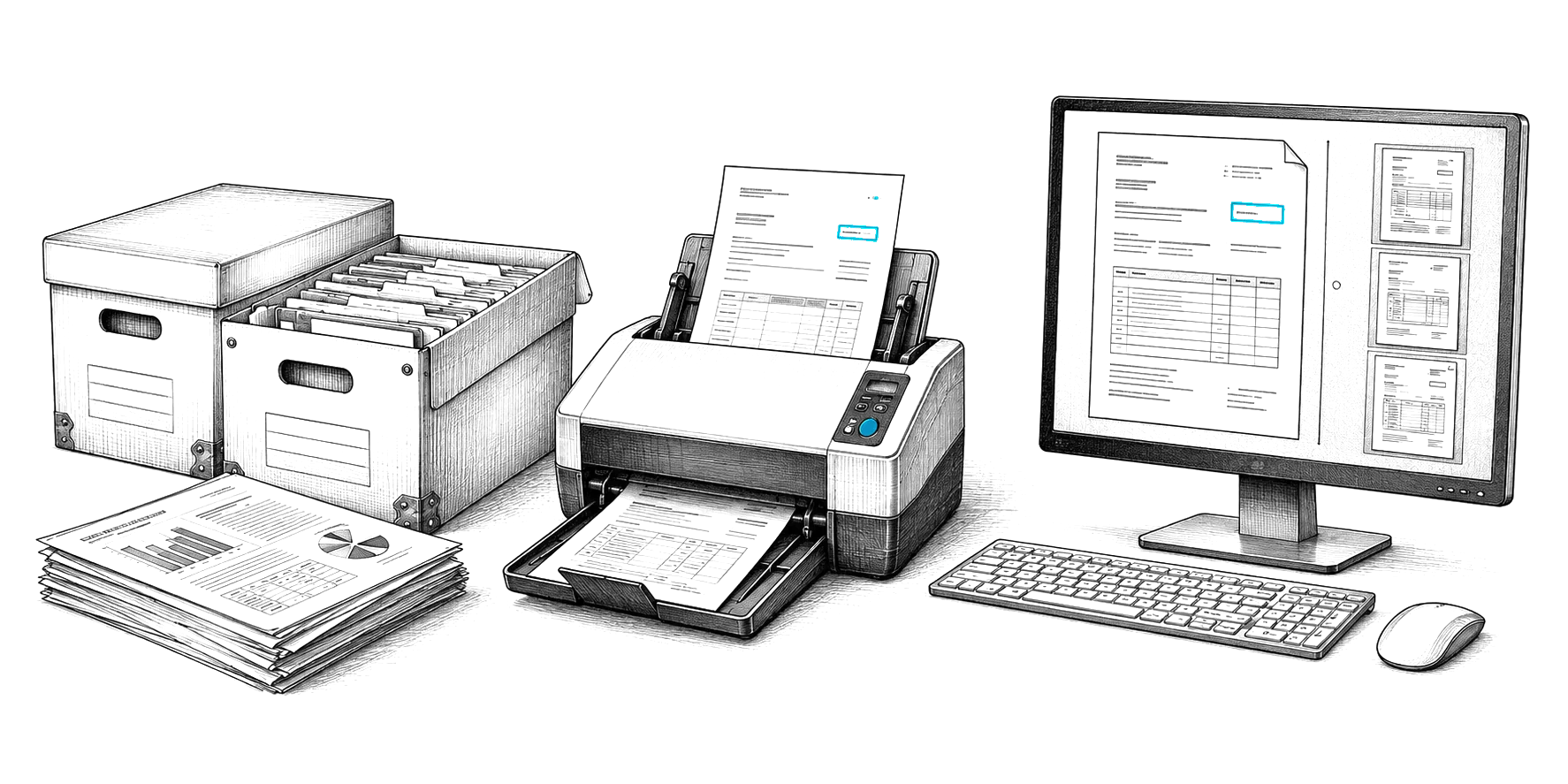
Put a mixed stack of invoices, receipts, expense reports and W-9s through the scanner. CapturePoint 6 splits it into documents, knows which is which, and reads what your auditor will ask about.

Invoice
Vendor, invoice number, dates, PO, total and every line item
Expense report
Employee, purpose, total reimbursement, approval date
Form W-9
Taxpayer name, business name, tax classification
Timesheet
Company name, regular pay and gross pay

Each file is named from what was read and sent to SharePoint or OneDrive, Google Drive, Dropbox or a folder. It learns from every correction, and the reading happens on your own PC.
Content Central · cloud or on-premises

When the auditor wants retention and a log.

One file per grant with missing documents flagged, invoice approvals before payment, exports to QuickBooks or Sage 50, retention schedules with holds, and a log of who opened what.

Nucleus One · in the cloud

A lighter app for forms, tasks and signatures.

Documents, intake forms, e-signatures for gift agreements and consent forms, tasks for report deadlines, and phone apps for staff in the field.

Straight answers for small teams.

Ademero has helped 1,000+ organizations get their paper under control since 2002.

We have no IT department. What can we actually run?

CapturePoint 6 installs on one Windows 10 or 11 PC next to your scanner and sends files to the SharePoint, OneDrive, Google Drive or Dropbox you already use. Nucleus One is a lighter cloud app with nothing to install. Content Central runs in the cloud with no server to run, or on a Windows server you already keep, your choice.

Does this replace our donor database?

No. Keep your donor database for gifts, contacts and history. Ademero keeps the paper behind them: signed gift agreements, pledge forms and acknowledgment letters, filed by donor name or ID so they turn up next to the record you already have.

Will it work with our accounting software?

Content Central exports approved bills to QuickBooks Online, QuickBooks Desktop and Sage 50, and can fill vendor and GL account lists from your accounting system. CapturePoint 6 also saves a data file with every value it read next to each finished PDF.

Can program staff use it in the field?

Nucleus One runs in the browser and has iOS and Android apps, with forms and e-signatures, so field staff can open a client file and send a consent form for signature without a trip back to the office.

Free live demo

Bring last year's audit request list. We will show you where each item would live.

Book a free demo and we will show you around, answer your questions and run your real paperwork through it. No cost, no pressure.

  • A live tour of the products that fit your work
  • Your own documents, set up and shown working
  • Your workflow and process, mapped with you
  • Straight answers from people who build it
Engraved illustration: file boxes, a document scanner and a PC at a desk