Property management · Brokerage · Title and escrow
Every lease, closing file and vendor bill, filed to its property.
Scan the day's mail and the signed paperwork. CapturePoint 6 splits the stack, reads it, and files every page under the right property, unit or transaction, so the next person to need it finds it in seconds.
No sign-up. Download it and start using it today.
Property management
Hundreds of units. Every bill and lease in the right unit's folder.
Property managers, leasing agents and the bookkeeper who pays the bills all work from the same pile: maintenance invoices, utility bills for vacant units and common areas, signed leases, inspection reports, notices to vacate, and a W-9 from every new vendor.
The pile is where it goes wrong. An electric bill for a vacant unit sits unpaid until the past due notice arrives. A plumber's invoice gets paid twice because one copy was emailed and one was mailed. A renewal starts late because the lease end date lived only on page one of a paper lease.
Bills read and filed by property.
Point CapturePoint 6 at a folder of your own invoices and utility bills and it sets up these documents from them. The service address and account number on a utility bill say which property it belongs to. Every line item on an invoice is read and its math checked.
| Document | What it reads |
|---|---|
| Invoice | Vendor, invoice number, dates, PO, total, every line item |
| Utility bill | Account number, service address, bill date, due date, total |
| Utility statement | Account number, statement date, payment due, closing balance |
| Past due notice | Account number, notice date, due date, service type |
| Form W-9 | Taxpayer name, business name, tax classification, TIN |
Leases that start their own renewals.
In Content Central, the lease end date is a field on the lease. One workflow rule watches it and emails the right people ahead of time, with no calendar to keep.
Brokerage
A transaction file the broker can sign off without hunting.
The managing broker reviews every file. The transaction coordinator builds it from what agents send: photos of signed pages, emailed PDFs, and the occasional stack dropped on a desk. The commission can't be released until the file is complete.
With Content Central, a transaction file is set up once as a checklist of document types, keyed on the transaction number. Anything filed with that number joins the file, and the file shows exactly what is still missing. A report lists every incomplete file, so broker review stops being a scavenger hunt.
When the file is complete, it goes to the broker for approval as one item. Approvals can stamp the approver's signature, and Content Central can request signatures from anyone with an email address.
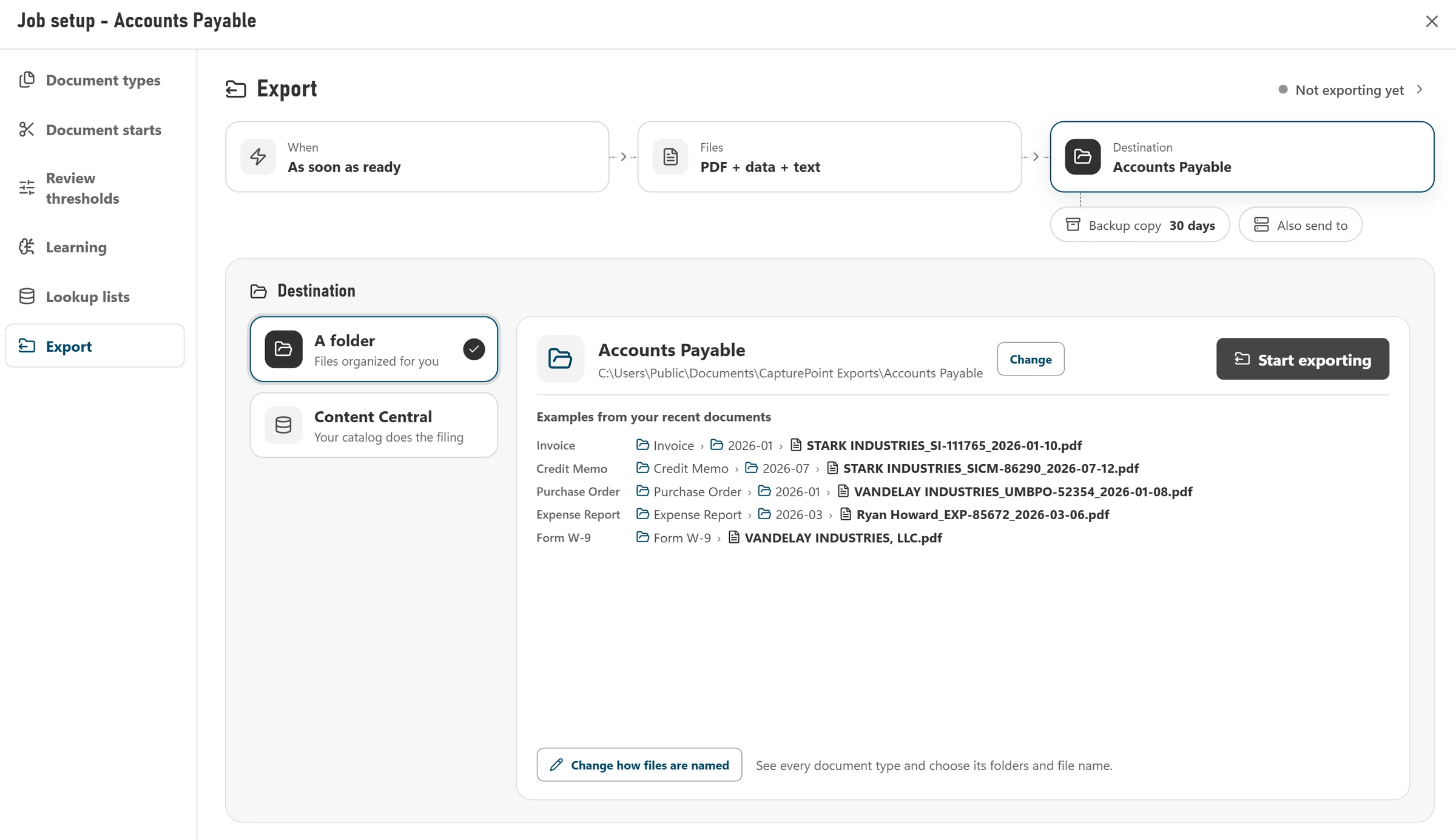
Small brokerage on Google Drive, Dropbox or SharePoint? CapturePoint 6 scans and names the pages and sends them straight to the deal's folder there.
Transaction 2291
118 Maple Court, buyer side
- Listing agreementFiled
- Agency disclosureFiled
- Seller’s property disclosureFiled
- Lead-based paint disclosure (pre-1978)Filed
- Purchase agreement and addendaFiled
- Earnest money receiptFiled
- Inspection report and repair addendumMissing
- Settlement statementMissing
- Commission disbursement authorizationMissing
Title and escrow
The closing is over. The paper keeps coming.
Escrow officers and closers live on deadlines, and post-closing lives on trailing documents: recorded deeds coming back from the county weeks later, final title policies, payoff confirmations. Each one has to find its file.
Before closing
Title commitment, payoff statements, tax certificates, HOA estoppel letters, survey
Content Central picks up emailed payoffs and estoppels from a shared mailbox and files them by the file number in the subject.
At the table
Settlement statement or Closing Disclosure, deed, deed of trust or mortgage, affidavits
CapturePoint 6 splits the signed package into named documents on the closer’s PC.
After closing
Recorded documents, final title policy, 1099-S, disbursement records
Set up a job from a folder of your own recorded documents. It finds the fields by itself.
In Content Central, file access is set by role and document type, users can be required to give a reason before opening a file, and every view is logged. Retention runs per document type, so closed files leave on schedule and anything under a claim can be held.
A worked example
Monday's mail at a property management office, in one pass through the scanner.
One mixed stack goes in. CapturePoint 6 splits it into documents, reads each one and files it into Content Central, where workflow rules send approvals and emails. Lease documents are a type you add once from a folder of your own leases.
- 01Plumbing contractor invoiceVendor, invoice number, total, 3 line itemsMaintenance / 410 Harbor St / Unit 3B, and on to the manager for approval
- 02Electric bill, vacant unitAccount number, service address, payment dueUtilities / 410 Harbor St / Unit 1B
- 03Water past due noticeAccount number, notice date, due dateUtilities / 22 Elm Court, and an email to the bookkeeper
- 04Form W-9, new landscaperTaxpayer name, tax classification, TINVendors / landscaper, ready for year-end 1099s
- 05Lease renewal, Unit 2BTenant, unit, new lease end dateLeases / 410 Harbor St / Unit 2B, next to the original lease
- 06Notice to vacate, Unit 4CTenant, unit, move-out dateLeases / 22 Elm Court / Unit 4C, and an email to the manager
Every page someone confirms teaches it. After steady use, most of Monday's mail goes straight through without anyone looking.
The rules each desk keeps paper for.
The periods are yours to set from your state's rules and your counsel's advice. Ademero keeps each document type on the schedule you choose.
- State license law and commission rules
- Your state real estate commission sets what a complete transaction file holds and how many years the broker keeps it, often including deals that never closed.
- Lead-based paint disclosure
- For housing built before 1978, sellers, landlords and their agents keep a copy of the signed disclosure for at least three years.
- Security deposit laws
- State and local law sets how deposits are held and when itemized deductions are due. The move-in and move-out inspection reports are your evidence.
- GLBA and ALTA Best Practices
- Title and settlement companies protect customers’ nonpublic personal information. ALTA’s Best Practices ask for a written privacy and information security program.
- IRS Forms W-9 and 1099
- A W-9 on file for every vendor you pay, so year-end 1099s go out right. Settlement agents also report sales on Form 1099-S.
Brokerages
Brokerages and landlords
Property managers
Title and escrow
Everyone who pays vendors
Scan this week's pile and watch it file itself.
CapturePoint 6 runs on your own Windows PC with the scanner you already have. Its AI reads every page right there, and the finished files go to folders, Content Central, SharePoint or OneDrive, Google Drive, Dropbox or Nucleus One.
No sign-up. Download it and start using it today.
Want lease reminders and transaction files? Book a demoGuides, templates and solutions for real estate paperwork
- Utility bill data extractionGuide
- W-9 form data extractionGuide
- Invoice line item extractionGuide
- Batch scanning and document separationGuide
- Scan to Google DriveGuide
- File naming conventionTemplate
- Invoice approval matrixTemplate
- Contract and lease managementSolution
- Document packetsSolution
- Electronic signaturesSolution
- CapturePoint help libraryHelp
Ademero has built document software since 2002 for more than 1,000 organizations. Fortune 500 companies and government agencies review its security every year.