Integrations
Read once. Sent where it needs to go.
Nobody should retype a document into a second system. Here is every place Ademero products send documents and data, product by product, with the guide for each one.
CapturePoint 6 free trial: no form, it starts the first time you open it.
Jump to
CapturePoint 6
Scan once. Filed where your team already looks.
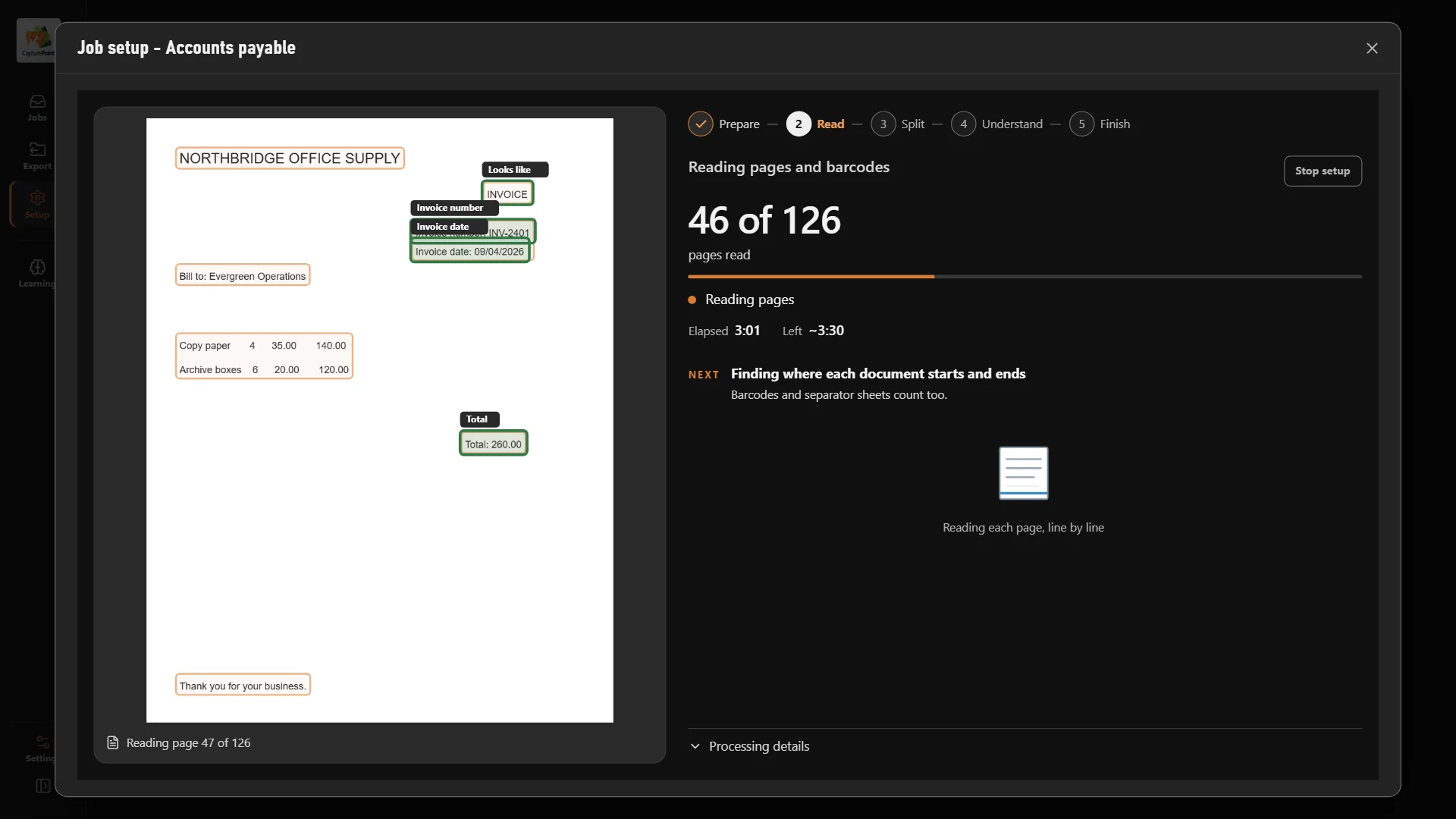
CapturePoint 6 reads every document on your own Windows PC, then files it as a named, searchable PDF in your folders or Content Central. It can also send each finished PDF, with its values attached, to a cloud destination.
Your own folders
Local or network
Folders and file names built from the data on each document, like vendor, date and invoice number. You get a searchable PDF (PDF/A if you want it), a data file with every captured value and a text file.Content Central
In the cloud or on your own servers
Connect once, pick the catalog and match fields. Each document arrives filed and indexed, ready for search and workflows.SharePoint and OneDrive
Microsoft 365 work or school accounts
Each finished PDF goes to the library or folder you choose. SharePoint can fill columns that have the same name as your fields.Google Drive
Each finished PDF goes to the Drive folder you choose, with the captured values in the file details.Dropbox
Each finished PDF goes to your Dropbox, with the captured values embedded in the PDF.Nucleus One
Connects with an API key
Each finished PDF goes into Nucleus One, and captured values fill fields with the same name.
CapturePoint how-to guides are at help.ademero.com/capturepoint.
Content Central
Approve the invoice. The bill is already in accounting.
Content Central exports approved documents and their data into your accounting, ERP and CRM systems as a step in a workflow. Every connection below is built into the product.
Accounting, ERP and CRM exports
QuickBooks Online
Connects with your Intuit sign-in
Approved invoices go across as account-based bills, with one expense line or many.QuickBooks Desktop
Bills and checks, with one line or many.Sage 50
US and Canada
Approved invoices go across as bills, with one line or many.Sage X3
Documents and their data sent through the Sage X3 web service, mapped field by field.Workday
Account-based records, with one line or many.Epicor
Multi-line account-based records.Microsoft Dynamics CRM
An activity record written to Dynamics CRM for the document.
How an export is set up
Set it up once. It runs on every approval.
- Duplicate detection before anything is sent
- An export status on every document: success, failure or duplicate
- An export queue and history to see what went where
Three steps
Connect, map, trigger.
- 01
Connect
An administrator adds the connection once, for example by signing in to QuickBooks Online.
- 02
Map
Match document fields to the accounting fields: vendor, amount, GL account and line items. Vendor and GL lists can fill your dropdowns.
- 03
Trigger
A workflow rule decides when it runs, usually on final approval. Duplicates are caught, and each document shows whether its export worked.
Content Central
Lookups, email, Office and everything else.
The connections that keep data typed once: fill fields from another database, capture straight from a mailbox, and let other systems deliver documents.
Database lookups
Any ODBC database
Type or scan a vendor number and the rest of the vendor details fill in from your ERP or any other ODBC database. Lookups run at capture, in the Coding Queue or from a workflow, and can offer a pick list.Mailbox capture
Microsoft 365, Gmail or any IMAP mailbox
Content Central watches a mailbox and files the attachments, the message, or both. From, To, Subject, Date and Body can fill index fields.API connections
For document delivery and lookup
Revocable keys that only reach the catalogs you choose. Other systems can deliver PDF documents, search by field values and download the current file. CapturePoint 6 uses the same kind of connection.Office and Outlook add-in
Word, Excel, PowerPoint, Outlook, Visio, Project
A Content Central ribbon to file a new document, update one or check it out without leaving the Office app.Folder hand-offs
For systems with no API
Workflows can drop the file plus an XML data file into a folder another system watches, and watched folders bring files in the other way.Nucleus One migration
A move, not a sync
Moving to Nucleus One? Content Central can move documents across and check each one arrived.
Paige
Need the data, not the file?
Paige reads documents in the cloud and returns clean fields and line items. Collect the results three ways: download them, pick them up by SFTP, or have them pushed to your system by webhook the moment a document is done.
- Download from the Paige app
- SFTP pickup
- Webhook delivery
Nucleus One
Nucleus One connects too.
Nucleus One connects to the rest of your apps through Zapier, without code, and to your own software through its REST API. CapturePoint 6 can send scanned documents straight in.
Zapier
Connect Nucleus One to the apps your team already uses, without writing code.
REST API
Connect your own software and automate the work around your documents.
From Content Central
Move documents across from Content Central when you are ready to switch.
Developers
Building your own connection?
Start with the developer hub, then go deeper for the product you are connecting.
- Developer hubContent Central API connections, the Nucleus One REST API and Zapier in one place.
- Nucleus One API guideAuthenticate and work with documents in Nucleus One.
- Nucleus One integrationsZapier and the REST API, with examples.
- Content Central integrationsAccounting, ERP and CRM exports in more detail.
Questions about integrations.
Where can CapturePoint 6 send documents?
To your own folders or Content Central, and on to SharePoint or OneDrive (Microsoft 365 work or school accounts), Google Drive, Dropbox or Nucleus One. Reading and extraction happen on your PC first.
Which business systems does Content Central connect to?
QuickBooks Online and Desktop, Sage 50 (US and Canada), Sage X3, Workday, Epicor and Microsoft Dynamics CRM. It can also look up values in any ODBC database, capture email from Microsoft 365, Gmail or IMAP mailboxes, and accept documents over API connections.
How does Paige hand over its data?
By download, by SFTP or by webhook, so the fields and line items it reads can flow into whatever system comes next.
How does Nucleus One connect to other apps?
Through Zapier and the Nucleus One REST API.
Our system is not on the list. Can we still connect it?
Often, yes. Content Central can hand off files and XML data through a watched folder, look up values in any ODBC database and accept documents over API connections. Tell us what you run and we will show you the best route in a free demo.
Free live demo
Tell us what you run. We will show you it connected.
Book a free demo and we will show you around, answer your questions and run your real paperwork through it. No cost, no pressure.
- A live tour of the products that fit your work
- Your own documents, set up and shown working
- Your workflow and process, mapped with you
- Straight answers from people who build it