Colleges and universities · admissions, aid and registrar
Three offices. One student file. An application season that will not wait.
Admissions builds the file, financial aid adds to it, the registrar inherits it. In Content Central it is one file from the first application to the first enrollment certificate, and each office opens only its part.
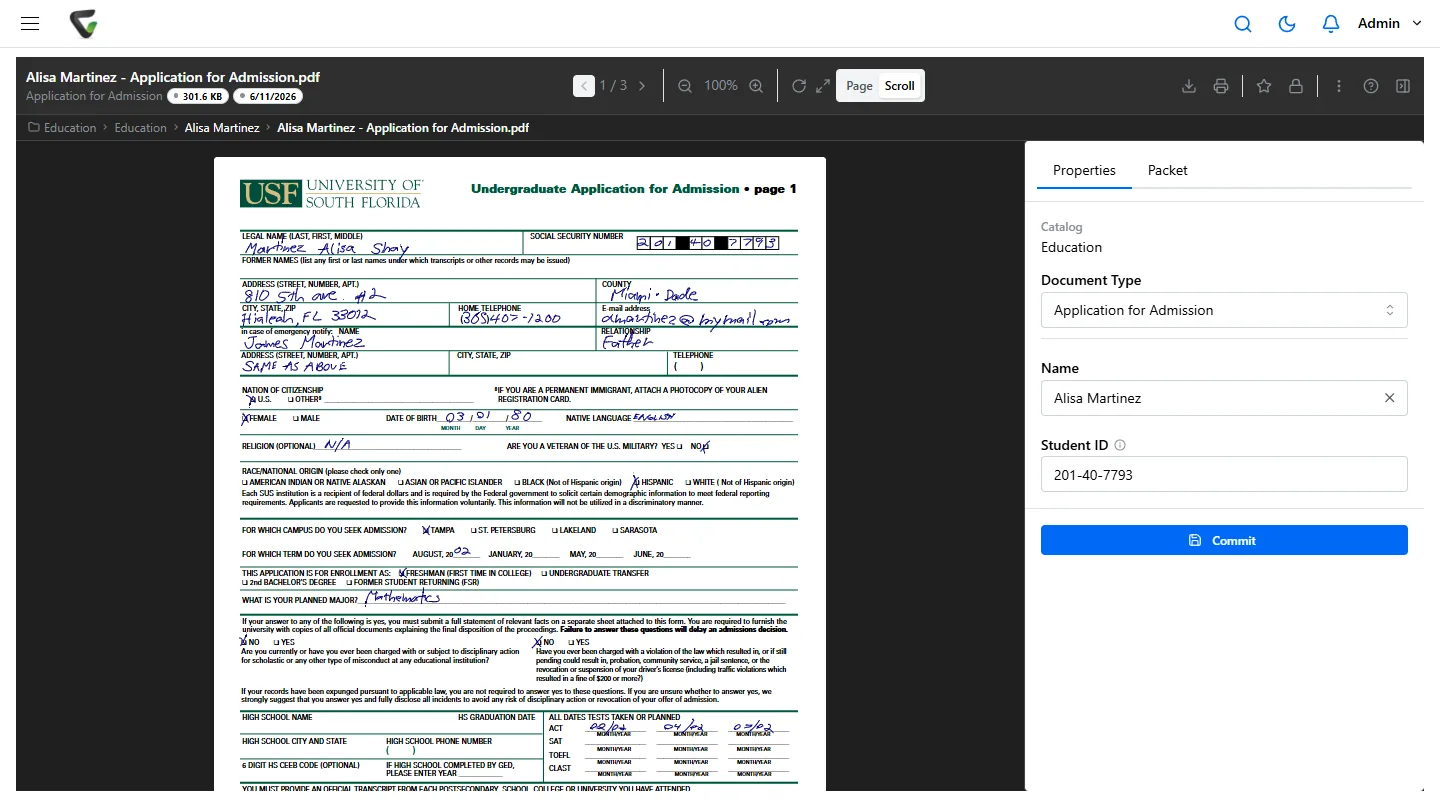
The file changes hands four times a year.
Each office has its own rush, and each rush lands paper on a file another office started. This is where documents go missing: at the handoffs, not in the drawers.
Each office adds its paper, opens its part and never sees the rest.
At a college, FERPA rights belong to the student, and staff may open a record when they have a legitimate educational interest as your annual notice defines it. Permissions per document type turn that definition into something the system enforces.
Admissions
Adds to the file
- Application for admission
- Secondary school transcript
- Official score report
Opens
The applicant’s file until the student enrolls.
Never sees
Aid award details and tax documents.
Financial aid
Adds to the file
- Financial aid award notice
- Verification documents
Opens
Aid documents, and the application only to confirm enrollment status.
Never sees
Conduct records and transfer credit decisions.
Registrar
Adds to the file
- Transfer credit evaluation
- Degree progress audit
- Enrollment verification certificate
- Official transcript
Opens
The academic record from the day the student enrolls.
Never sees
Aid award details.
An example setup. You choose the document types and the groups.
Where files go missing
Four handoffs that break every summer, and what catches each one.
The final high school transcript reaches admissions after the student belongs to the registrar.
A workflow rule can send final transcripts, the ones showing a graduation date, to the registrar’s work queue as they are captured, instead of an admissions inbox.
Transfer credit waits on transcripts admissions collected months ago.
Both are in the same student file, keyed on student ID, so the evaluator opens the outside transcripts beside the evaluation with no request to another office.
A residency affidavit sits on a desk while tuition bills go out.
A signed affidavit of domicile starts an approval for the residency officer, with a deadline and a reminder, and escalates if it waits too long.
Aid is on hold for one missing verification page, and nobody knows which students.
The Incomplete Packets report lists every file still missing a required document. Schedule it weekly, or have a rule email the aid office about each one after your deadline.
Mail, email and uploads, into the same file.
The admissions mailbox
Content Central picks up transcripts and score reports sent to a Microsoft 365, Gmail or IMAP mailbox. If the student ID is not on the page, the document waits in the Coding Queue until someone types it once.
The mailroom stack
Point CapturePoint 6 at a folder of your own applications, transcripts, score reports, award notices and affidavits of domicile, and it sets up the job from them. It splits the stack, reads the student ID on the scanning PC and sends each document to Content Central with its fields.
The rules, as they reach a college.
- FERPA
- Students can inspect their records, and you keep a record of most disclosures outside the institution. Every view, download and email is logged with user, time and recipients.
- Federal student aid records
- Generally kept at least three years after the end of the award year. Give aid document types their own retention period, separate from the academic record.
- Sensitive records
- For conduct records or anything your policy treats with extra care, Require Reason for Access asks staff why they are opening it and keeps the answer.
Bring admissions, aid and the registrar to one demo.
We will build one student file with your own forms, set each office's permissions, and run the handoff your team fights about most.