Purchasing
Purchase requisitions
Fill vendor details from your accounting database with a lookup, then route anything over a set amount to a second approver.
- Lookup
- Approval
Content Central · Electronic forms
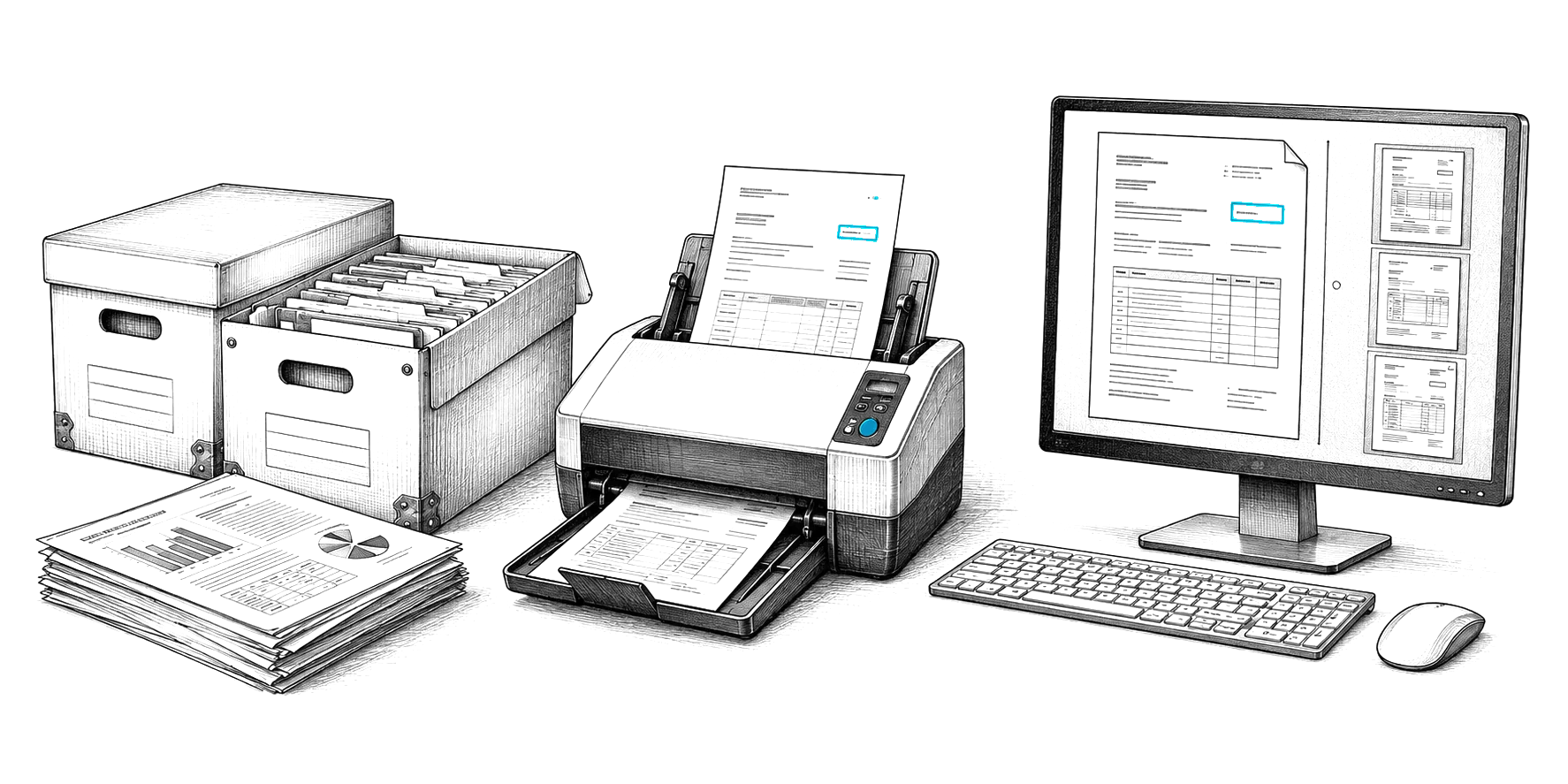
Someone fills in a paper form, then someone else types it all in again. Content Central turns the form into a fillable PDF. The moment it is submitted, the page and its data are filed together and the next step starts on its own.
The problem
Handwriting nobody can read, and the blank box nobody noticed until the form was already filed.
Every answer is typed into another system one field at a time, and every retype is a chance for a typo.
The form sits in a tray or an inbox until whoever approves it finds it.
01How it works
A capture form is a fillable PDF attached to a document type. Each PDF field feeds the index field with the same name, so there is nothing to map and nothing to index by hand.
Use any PDF editor that creates fillable fields. Name each field after the index field it should fill, such as Amount or Department.
Upload the PDF to the document type. Fields the type does not have yet are created for you.
Staff choose Capture New, then Form, fill in the fields, preview the finished page and click Finish. Outside people fill in the PDF they were emailed.
The completed PDF becomes the document and the answers become its index fields. No Coding Queue, no retyping.
02Outside people
Customers, applicants, new hires and vendors do not need an account. Email them the form and they fill it in and click Submit.
03Page and data in step
Fields that print on the form stay in sync with the document’s data. Pick how far that goes for each form.
| Always rebuild | Change a field in Content Central and the PDF is redrawn with the new value, saved as a new version. |
|---|---|
| Rebuild until signed | The page stays in step with the data until someone signs it. After that it is never redrawn, so the signature is safe. |
| Never rebuild after capture | The submitted page is kept exactly as it was filled in. Later field edits change the data only. |
04What happens next
Workflow rules can watch for capture form submissions, so the next step starts the moment a form is filed.
Email the right person, assign the form to a work queue, update fields or drop a copy where another system picks it up.
Start a multi-step approval, for example a second approver when the amount is over your limit.
Approvers sign as they approve, at spots you set once. Rebuild until signed keeps that signature on the page.
Fill vendor details from your database, and let the form join its packet by a shared key such as Employee ID.
Forms that work well
Purchasing
HR
Local government
Finance
Need something lighter?
Content Central runs in the cloud or on your own servers. If your team wants a lighter cloud app instead, Nucleus One brings online forms, e-signatures, tasks and client portals together, in the browser and on iOS and Android.
About Nucleus OneNo. Capture forms are ordinary fillable PDFs (AcroForm), built in any PDF editor and uploaded to a document type. Field names match index fields by name, and capitalization does not matter.
Yes. Email the form from Content Central, by hand or from a workflow rule. The recipient fills in the PDF and clicks Submit while the link is valid (12 hours by default). The submission is saved as a new version of that same document, and its history records the submitter’s IP address.
No. Outside submissions always go back to the document you emailed. There is no public form page or portal. Staff start new forms from Capture New, then Form.
You choose. The PDF can always be redrawn with the new values, redrawn only until it is signed, or never redrawn after capture. Each redraw is saved as a new version.
Yes. A workflow rule can react to capture form submissions and email someone, start an approval, assign the form to a work queue and more. If an approval stage carries a Signature Definition, the approver signs the form as they approve it.
We will turn it into a capture form on a live system, submit it, and show it filed with its data and on its way to an approver.
Keep going
Help library
Free live demo
Book a free demo and we will show you around, answer your questions and run your real paperwork through it. No cost, no pressure.