BlogTechnology Strategy
Cloud or on-premises document management: how to choose
On your own servers, every document stays inside your walls and your IT team runs it. In the cloud, nothing to install and nothing to maintain. A fair guide to picking the right one.
The demo is free and runs on your own documents, with no pressure.
Ademero Team7 min read
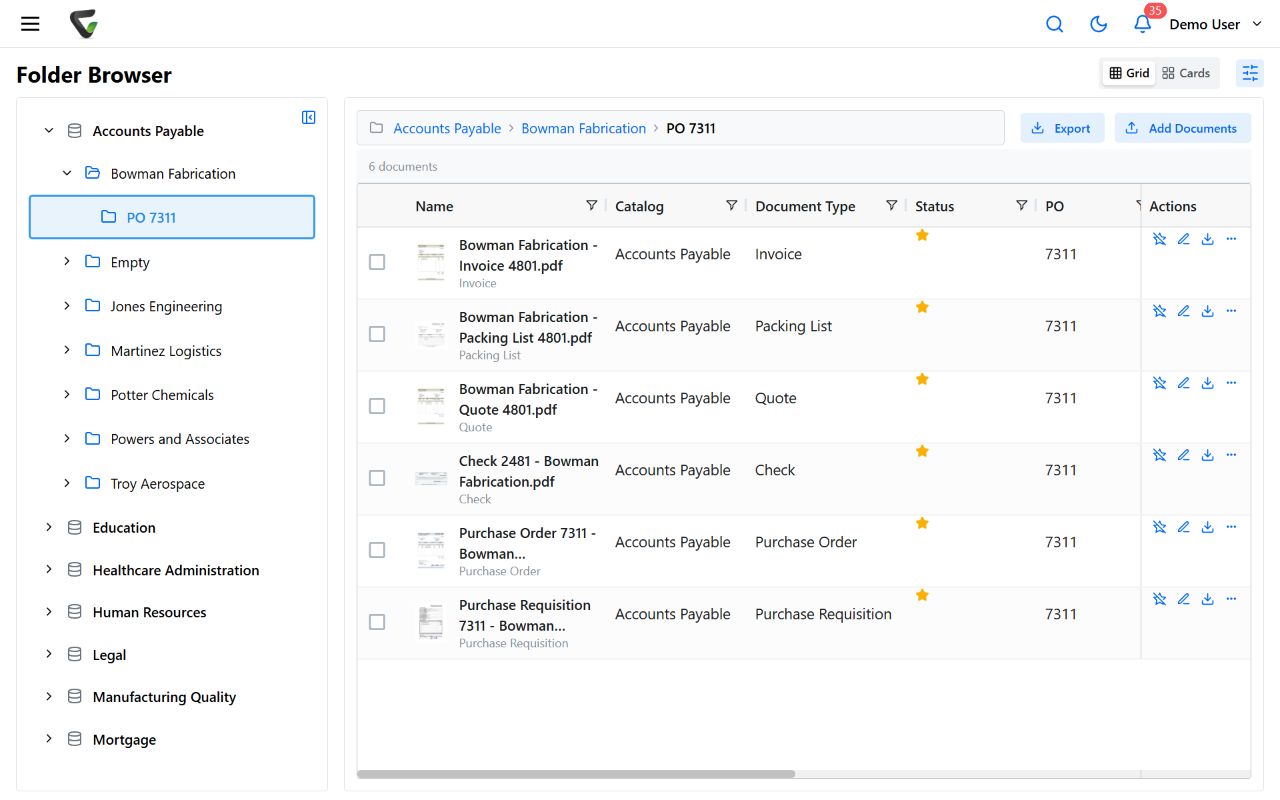
Where your document management system runs decides who maintains it, who can reach the documents, how fast scanning feels and what you pay over the years. Neither answer is right for everyone. Ademero offers both: Content Central, our full document management system, comes hosted in our cloud or installed on your own servers, your choice. So this guide is not here to talk you into one. It is here to help you pick the one you will still be happy with in five years, and to show where our lighter cloud app, Nucleus One, fits.
The short answer
Side by side
The general trade-offs first, then where the two Ademero products fit. Content Central is the one that lets you choose where it runs.
| Factor | On your own servers | In the cloud |
|---|---|---|
| Up-front cost | Higher: server, database and setup | Low: a subscription |
| Ongoing cost | Maintenance plus your IT time; flat as you grow | Grows with users |
| Who maintains it | Your IT team: patches, backups, capacity | The provider |
| Where documents live | Inside your network, under your policies | In the provider's data centers |
| Scanning speed | Local network speed for large batches | Depends on your internet upload speed |
| If the internet goes down | Office users keep working | No access until it is back |
| Remote and phone access | Through your network or VPN setup | Anywhere, by design |
| Content Central | Nucleus One | |
|---|---|---|
| What it is | The full document management system: records, approvals, retention and accounting exports | A lighter cloud app for teams: projects, tasks, forms and client portals |
| Where it runs | Your choice: hosted in our cloud, or on Windows Server, IIS and SQL Server in your building or data center | In the cloud: Google Cloud, run by Ademero |
| How people use it | In a web browser; approval queues work on phones | In a web browser, plus iOS and Android apps |
| Workflow | Rule-based engine: 25 trigger types, multi-step approvals with deadlines and escalation | Workflows, tasks and projects |
| Signatures | Built-in e-signatures, including signing as you approve | Built-in e-signatures with a signing order |
| Outside people | Shared links with expiry, signature requests and forms by email | Client portals |
| Connections | QuickBooks, Sage 50, Sage X3, Workday, Epicor, Dynamics CRM, database lookups | Zapier and a REST API |
| Records control | Retention schedules, legal holds, version history, full activity log | Every version kept, activity history on every document, roles per project |
| Sign-in | Active Directory, SAML single sign-on, authenticator-app MFA | Authenticator-app MFA, with an option to require it |
When your own servers fit
- The documents cannot leave your network. Customer contracts, security reviews or your own policy require it. On your own servers, your documents never leave your environment.
- You scan a lot. Large batches move at local network speed, not your upload speed.
- You already run Windows and Active Directory. People sign in with the accounts they already have, and your IT team applies its own backup and patching routine.
- Approvals and accounting are the point. Invoices that route by amount, escalate after three days and export to QuickBooks, Sage or Workday once approved.
- Records management matters. Retention schedules per document type, legal holds and a full activity log for the auditor.
Watch for: someone has to own the server. Budget for the hardware or virtual machine, SQL Server, backups, and regular IT time for updates. Content Central go-live is a 30-day commitment, so the project itself does not have to be long. If the needs above fit but owning a server does not, Content Central also comes hosted in our cloud.
When the cloud fits
- No server and no IT team to spare. Updates, backups and capacity are the provider's job.
- People work everywhere. Field staff, home workers and several small offices, many of them on phones.
- Clients and outside partners are part of the work. A client portal beats emailing attachments back and forth.
- You want to start this week. Sign up, start filing right away, and add workflows as you go.
- Your apps are already in the cloud. Zapier and an API connect it to the tools you use.
Watch for: every user needs a working internet connection, cost grows with the team, and very large scanning batches depend on your upload speed.
In Ademero terms: if you want the full document management system in the cloud, with approvals, retention and accounting exports, that is Content Central in the cloud. If your team mainly wants projects, tasks, forms and client portals in a lighter app, that is Nucleus One.
Five-year cost
Compare at least five years, not the first invoice. List every line for both options:
| Cost | Cloud | On-premises |
|---|---|---|
| Software | Ongoing subscription | License plus annual maintenance |
| Hardware | None | Servers, storage and networking |
| IT staff | Light administration | Ongoing administration |
| Support and upkeep | Included | Your responsibility |
| Training and setup | Mostly up front | Mostly up front, often longer |
| Security and compliance | Shared with the provider | Fully yours |
Who secures what
In the cloud
The provider secures the infrastructure: data centers, hardware, network and the platform itself. You are still responsible for who has access, how permissions are set, whether multi-factor sign-in is required, and how your people use the system. Ask every provider which infrastructure they run on. Nucleus One runs on Google Cloud.
On your own servers
You control every layer and every policy, which is exactly why regulated organizations often choose it. It also means patching, monitoring, backups and physical security are your team's job. For healthcare, ask whichever vendor you pick whether they sign a business associate agreement. Ademero does.
Questions to ask any vendor
- Where exactly will our documents be stored, and who at your company can reach them?
- How do people sign in? Can we use our directory and require multi-factor sign-in for everyone?
- Can we set retention periods per document type and place a legal hold?
- What does the activity log record, and how long is it kept?
- How do we get every document and its index data out if we leave?
- What happens to scanning and approvals if the internet or a server goes down?
- Which accounting and line-of-business systems does it connect to today, without custom code?
- How long does a typical go-live take, and who does the setup?
Using both
Plenty of organizations split the work rather than picking one model for everything:
- By sensitivity: finance, HR and patient records on your own servers; project files and client collaboration in the cloud.
- By location: the head office on the server, small branches and field staff in the cloud.
- Over time: start with one model and change later. Ask any vendor, us included, how a move between models works before you commit. Content Central also includes migration actions that move documents to Nucleus One and verify each one.
Capture works the same either way. CapturePoint 6 splits a scanned stack into documents, reads the fields and sends each finished file to Content Central or Nucleus One, so the choice of library does not change how your scanning desk works. See intelligent document capture explained.
Making the decision
- 01
List your must-haves
Where documents may live, who must reach them, and the rules you answer to. - 02
Count your people and places
How many users, how many offices, how many work from phones or home. - 03
Map your processes
Which approvals, signatures and accounting exports the system must run. Start with the one that hurts most. - 04
Compare five-year cost
For each option, including staff time and hardware refreshes. - 05
Ask the questions above
Get the answers in writing from every vendor on your list. - 06
Pilot it
Run the leading option on real documents with the people who will use it every day.
Get the next guide by email
Practical notes on documents, capture and automation. No spam, unsubscribe any time.
Free live demo
See it work on your own documents.
Book a free demo and we will show you around, answer your questions and run your real paperwork through it. No cost, no pressure.
- A live tour of the products that fit your work
- Your own documents, set up and shown working
- Your workflow and process, mapped with you
- Straight answers from people who build it